Understanding AI Models: Your Guide to Machine Learning Brains

Circuit board with central processing unit (CPU) chip.

In the world of Artificial Intelligence (AI), models act as the virtual brains. Trained on data and algorithms, these models learn and evolve, making them valuable tools for various tasks. This guide dives into what AI models are, how they’re created, different types, and common applications.

What are AI Models?

AI models are essentially software programs trained on data to perform specific tasks. Imagine them as students constantly learning from information. The more data they process, the better they become at tasks like:

  • Analyzing large datasets
  • Identifying patterns
  • Predicting future outcomes
  • Generating creative content

Building an AI Model

Data scientists are the masterminds behind crafting AI models. They develop algorithms, which are step-by-step instructions that guide the model. These algorithms are then trained on data, transforming them into functional AI models.

Artificial Neural Networks (ANNs): Learning Like the Brain

ANNs are a specific type of algorithm modeled after the human brain. They consist of interconnected nodes (artificial neurons) that process information in a similar way to how our brains work. This structure allows them to excel at tasks requiring pattern recognition, such as:

  • Image and speech recognition
  • Summarizing documents
  • Natural Language Processing (NLP)
  • Complex decision-making

Search Engine Algorithms: A Real-World Example

A well-known example of an algorithm in action is Google Search. When you enter a query, Google’s search algorithm analyzes billions of web pages to deliver the most relevant and helpful results. As user behavior and search trends evolve, so too does the algorithm to maintain its effectiveness.

Exploring Different AI Model Types

There are various AI model types, each with its strengths and applications. Here’s a breakdown of the most common ones:

  • Machine Learning (ML): A subset of AI where models learn from data.
    • Supervised Learning: The most common type, trained with labeled data (data with predefined categories). Great for tasks like classification and prediction. [Backlink to a resource on supervised learning, e.g., scikit-learn documentation on supervised learning: https://scikit-learn.org/stable/supervised_learning]
    • Unsupervised Learning: Discovers patterns in unlabeled data, allowing for data exploration and grouping.
    • Deep Learning: A powerful subset of ML that uses complex neural networks to identify intricate patterns in data, often used for tasks like image recognition and natural language processing. [Backlink to a resource on deep learning, e.g., TensorFlow tutorials on deep learning: https://www.tensorflow.org/tutorials]

Deep learning models

Deep learning is an advanced type of ML that learns to identify complex patterns in text, images, and sounds. With deep learning, data is processed and classified through layers, and each layer has a role to play in the processing of input data.

Here’s a quick look at the different types of layers in a deep learning neural network:
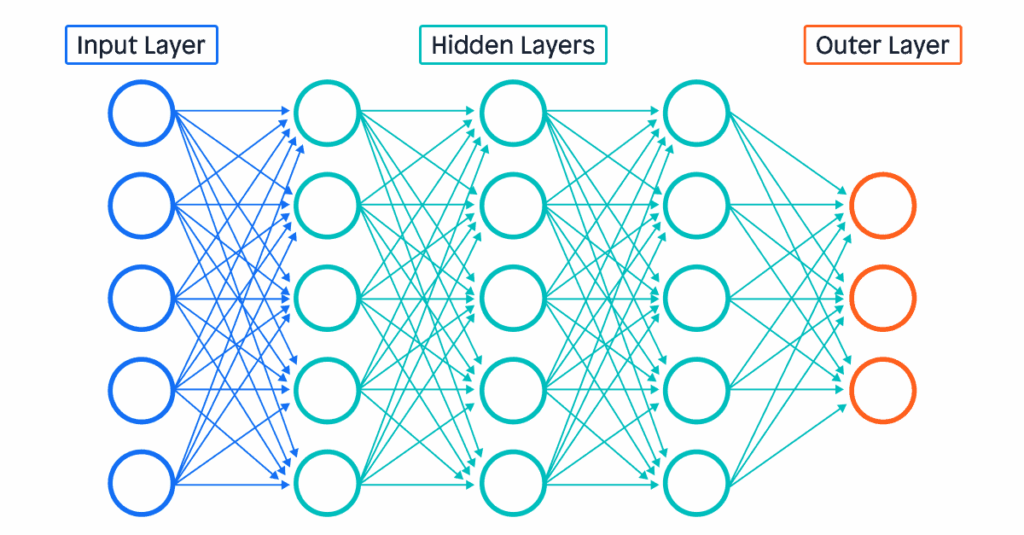
Source: https://www.mendix.com/blog/what-are-the-different-types-of-ai-models/

Machine Learning in Action: Teaching AI about Flowers

Let’s use flower identification as an example. To train a supervised learning model, we’d provide a dataset of labeled images (each flower with its name). The model analyzes this data, learning to differentiate flower types based on characteristics. Eventually, it can identify flowers in unseen images with increasing accuracy.

Common AI Models and Applications

The world of AI models is vast, with models for various purposes. Here are a few examples:

  • Common Machine Learning Models:
    • Linear Regression: Predicts continuous values (e.g., house prices based on size and location).
    • Logistic Regression: Classifies data into two categories (e.g., spam detection).
    • Decision Trees: Tree-like models used for classification and prediction tasks.
  • Common Deep Learning Models:
    • Convolutional Neural Networks (CNNs): Excellent for image processing tasks like classification and object detection.
    • Recurrent Neural Networks (RNNs): Handle sequential data like text and time series, often used for language modeling and machine translation.
    • Long Short-Term Memory Networks (LSTMs): A type of RNN capable of learning long-term dependencies in data sequences.

Conclusion

AI models are a transformative technology with vast potential. By understanding their capabilities and different types, you can leverage their power for various applications and contribute to the ever-evolving field of Artificial Intelligence.


Share

Related Content

News

Workshop “SMARTER MANUFACTURING with Mendix Low-Code”

Workshop “SMARTER MANUFACTURING with Mendix Low-Code” hosted by TBN Corporation PLC. This workshop was specifically designed for the manufacturing industry, showcasing how Low-Code technology can enhance efficiency, simplify complex processes, and digitize workflows seamlessly using Mendix. With Mendix, every factory can quickly develop customized solutions without the need for complex coding. Improve workflows, BPA, and data logic tailored to your business needs! Key Highlights of the Workshop: Boost Efficiency: Save time and costs with faster and error-free processes. Digitize Processes: Easily create systems tailored to your factory without requiring coding expertise. Explore Mendix Low-Code Platform: Leverage smart tools to optimize workflows, automate processes, and manage data logic efficiently. Why Mendix Low-Code for Manufacturing? Speed: Develop solutions faster than traditional coding. Flexibility: Tailor applications to your specific business requirements. Ease of Use: Reduce complexity in managing IT systems. Transform Your Factory for the Future! Join us in our next workshop to discover how Low-Code technology can drive your business success 🚀 Stay updated on upcoming workshops and events through our website! #SmarterManufacturing #LowCode #Mendix #DigitalTransformation

ceo intro
News

Nubitel: The Future of Communication by TBN Corporation

TBN Corporation PLC. unveiling Nubitel, an all-in-one unified communication platform designed to meet the demands of organizations in the digital era. The event was a resounding success, bringing together industry leaders from various sectors. 💡 Event Highlights: Live Demonstrations: Showcasing Nubitel’s cutting-edge features for seamless communication and collaboration. Executive Discussions: Exploring the future of enterprise communication and its impact on businesses. Networking Opportunities: Connecting with top executives from diverse industries. Nubitel: Redefining Communication for the Digital Age Nubitel is crafted to address every aspect of enterprise communication, including voice calls, video conferencing, and messaging. The platform ensures seamless integration across multiple devices and platforms, enabling effortless collaboration and enhancing organizational efficiency. TBN Corporation’s Vision “We believe Nubitel will transform organizational communication, driving efficiency and seamless collaboration. Backed by TBN’s trusted expertise, our solutions are future-ready and built for success.” About TBN Corporation As “Your Trusted Digital Solutions Partner,” TBN Corporation excels in delivering innovative, reliable solutions tailored to the unique challenges of today’s organizations while preparing them for future opportunities. Contact Us Ready to take your organization’s communication to the next level with Nubitel? 📞 02-258-5841 ✉ sales@tbn.co.th   #TBNCorporation #Nubitel #DigitalTransformation #UnifiedCommunications #BusinessInnovation

News

TBN Drives Digital Innovation with Mendix Low-code at HSBC Thailand Digital Bridge Day

TBN was proud to participate in the recent HSBC Thailand Digital Bridge Day, where we shared insights on how Mendix Low-code can revolutionize the way businesses operate. Leveraging AI for Business Advantage Our presentation highlighted the power of combining Mendix with AI to drive innovation and efficiency. By automating tasks and gaining deeper insights from data, businesses can make informed decisions and stay ahead of the curve. Key Benefits of Mendix Low-code: Rapid Application Development: Build custom applications in a fraction of the time. Enhanced Agility: Quickly adapt to changing business needs. Improved Collaboration: Foster seamless teamwork between business and IT. Lower Development Costs: Reduce development expenses and time-to-market. Real-world Applications To illustrate the practical applications of Mendix, we showcased real-world examples: Automated Tax Analysis: Streamline tax processes and accelerate refunds. Seamless Financial Solutions: Connect disparate systems for efficient operations. Partnering for Digital Success HSBC Thailand’s Digital Bridge Day provided a platform to connect with industry leaders and explore the future of digital transformation. TBN is committed to collaborating with forward-thinking organizations like HSBC to drive innovation and empower businesses. Are you ready to embark on your digital journey? Contact TBN today to learn how Mendix and AI can help you achieve your business goals. sales@tbn.co.th